Navigating the Electric Vehicle Battery Market: A Practical Guide for 2026
The global shift towards electric mobility is accelerating at an unprecedented pace. As of early 2026, markets from Europe to Southeast Asia are seeing record sales of E-bikes, E-scooters, and E-tricycles, driven by both environmental policies and consumer demand for cost-effective transportation. At the heart of this revolution lies the lithium battery – the component that defines range, performance, and total cost of ownership. For businesses, fleet operators, and individual buyers, selecting the correct E-bike lithium battery or E-motorcycle lithium battery is a critical decision that impacts operational efficiency and profitability.
This guide is designed to demystify the selection process. We'll explore key technical considerations, compare different battery chemistries, and explain how a manufacturer's expertise, like that of HAIYOU (Jiangxi Jinhaiyou New Energy Resources Technology Co., Ltd.), translates into real-world benefits for your electric vehicle applications.
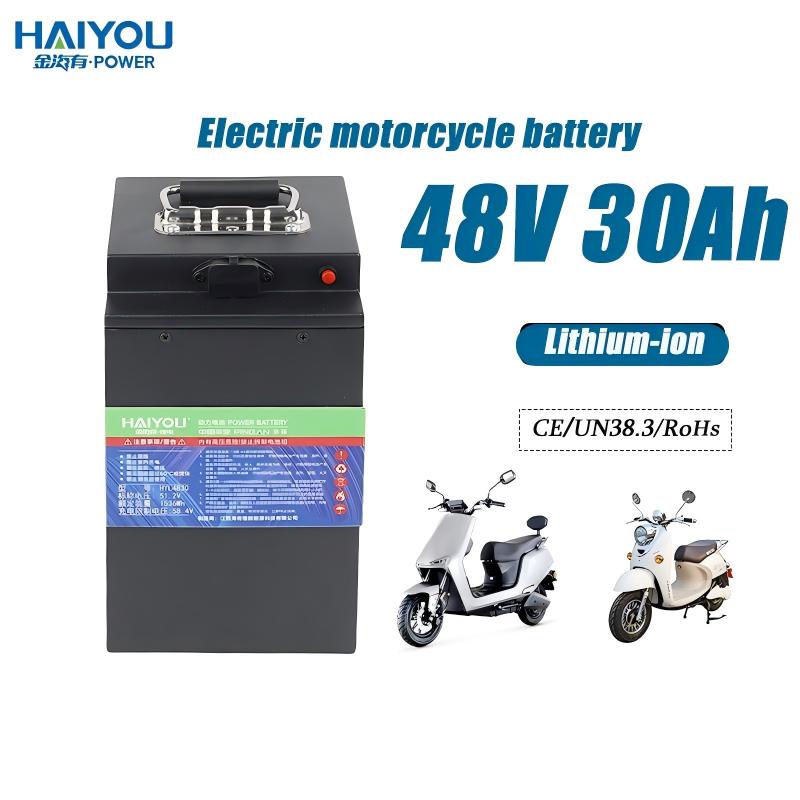
A robust 48V30Ah LFP battery designed for reliable electric two-wheeler performance.
Step 1: Understand Your Core Application and Voltage Requirements
The first step is defining your use case. The power demands of a delivery E-tricycle lithium battery are vastly different from those of a personal E-scooter lithium battery.
- Electric Two-Wheelers (E-bikes/E-scooters): Common voltages are 36V, 48V, 60V, and 72V. A 48V or 60V system often provides the best balance of power and efficiency for urban commuting. For example, HAIYOU's 60V40Ah NCM battery offers a strong power output suitable for moderate hills and longer commutes.
- Electric Tricycles & Low-Speed Four-Wheelers: These vehicles require higher capacity and often higher voltage (60V, 72V) to handle heavier loads. A 72V100Ah LFP battery or even a 72V300Ah LFP battery from HAIYOU's product line is engineered for this demanding duty cycle, ensuring all-day operation for cargo or passenger transport.
- Electric Motorcycles: Performance is key, requiring high discharge rates and stable voltage under load. High-capacity 72V systems are typical.
- Golf Carts & Specialized Vehicles: While often using 48V or 72V systems, the focus is on deep-cycle capability and longevity. A dedicated golf cart lithium battery is built for repeated, deep discharges.
Step 2: Choose Between NCM and LFP Battery Chemistry
This is the most crucial technical choice. Two dominant lithium technologies are used in EVs today:
NCM (Nickel Cobalt Manganese) Batteries
Pros: Higher energy density (more range in a smaller, lighter pack), better performance in cold weather, higher discharge rates (good for acceleration).
Cons: Generally shorter cycle life, higher cost per cycle, more sensitive thermal management needs, and concerns around cobalt sourcing.
Best For: Performance-oriented E-bike and E-motorcycle applications where weight and peak power are critical. HAIYOU offers options like the 72V40Ah NCM battery for such needs.
LFP (Lithium Iron Phosphate) Batteries
Pros: Exceptional cycle life (often 3000+ cycles), superior safety and thermal stability, lower cost per cycle over lifetime, cobalt-free.
Cons: Lower energy density (heavier/bulkier for same capacity), slightly lower voltage, performance can dip in extreme cold.
Best For: Commercial fleets (E-tricycle, delivery vehicles), energy storage applications, and any use case where safety, total cost of ownership, and longevity are paramount. HAIYOU's extensive LFP range, including the 72V20Ah LFP battery for two-wheelers and large 60V180Ah LFP battery for trikes, exemplifies this strength.
The industry trend in 2026 is clearly leaning towards LFP for most commercial and utility applications due to its durability and safety, while NCM retains a stronghold in the premium performance segment.
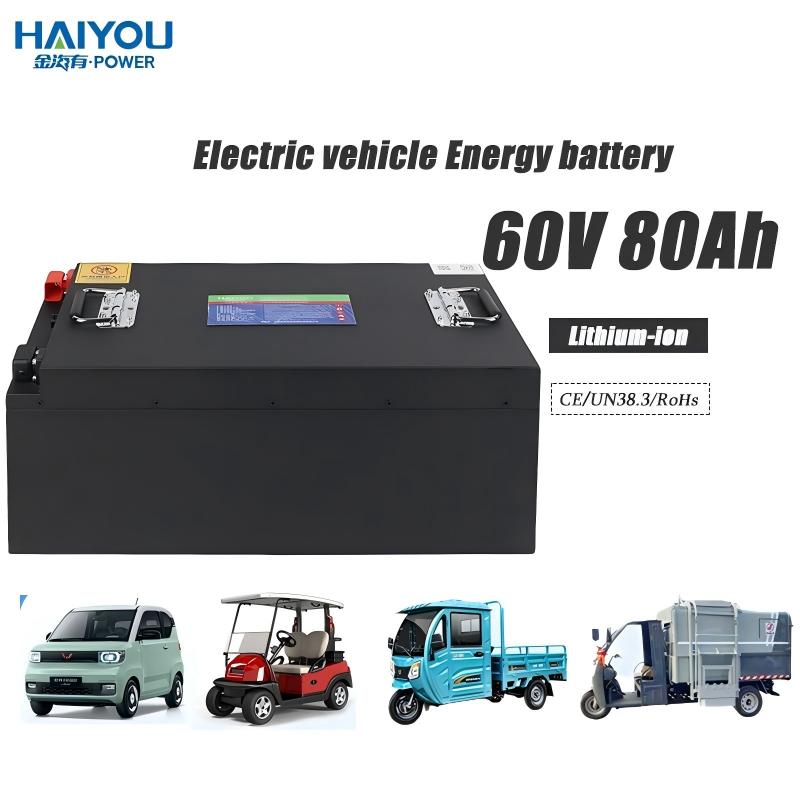
HAIYOU's 60V80Ah LFP battery pack, built for the demanding cycles of electric tricycles.
Step 3: Evaluate Capacity (Ah), Energy (kWh), and Range
Capacity (Ampere-hours, Ah) and Energy (Kilowatt-hours, kWh) determine your range. A simple formula: Voltage (V) x Capacity (Ah) = Energy (Wh). Divide by 1000 to get kWh.
For instance, HAIYOU's 60V100Ah LFP battery stores 60V x 100Ah = 6000Wh or 6kWh of energy. Actual range depends on vehicle efficiency, weight, and terrain, but more kWh means more potential distance. For solar applications, this same logic applies when pairing a solar battery with panels.
Key Question: Do you need a compact battery for a short commute (e.g., 48V30Ah) or a high-capacity workhorse for all-day delivery (e.g., 72V300Ah)?
Step 4: Prioritize Safety, BMS, and Certifications
A high-quality Battery Management System (BMS) is non-negotiable. It protects against overcharge, over-discharge, short circuits, and temperature extremes. Manufacturer credentials are your assurance of this quality.
Jiangxi Jinhaiyou New Energy Resources Technology Co., Ltd. (HAIYOU) underscores its commitment to safety and quality through international certifications. Their ISO9001 Quality Management System Certification ensures consistent production standards, while ISO14001 and ISO45001 certifications demonstrate responsible environmental and workplace safety practices. Furthermore, their portfolio of Patent Certificates reflects ongoing R&D into better, safer battery technologies, such as innovations in battery protection devices.
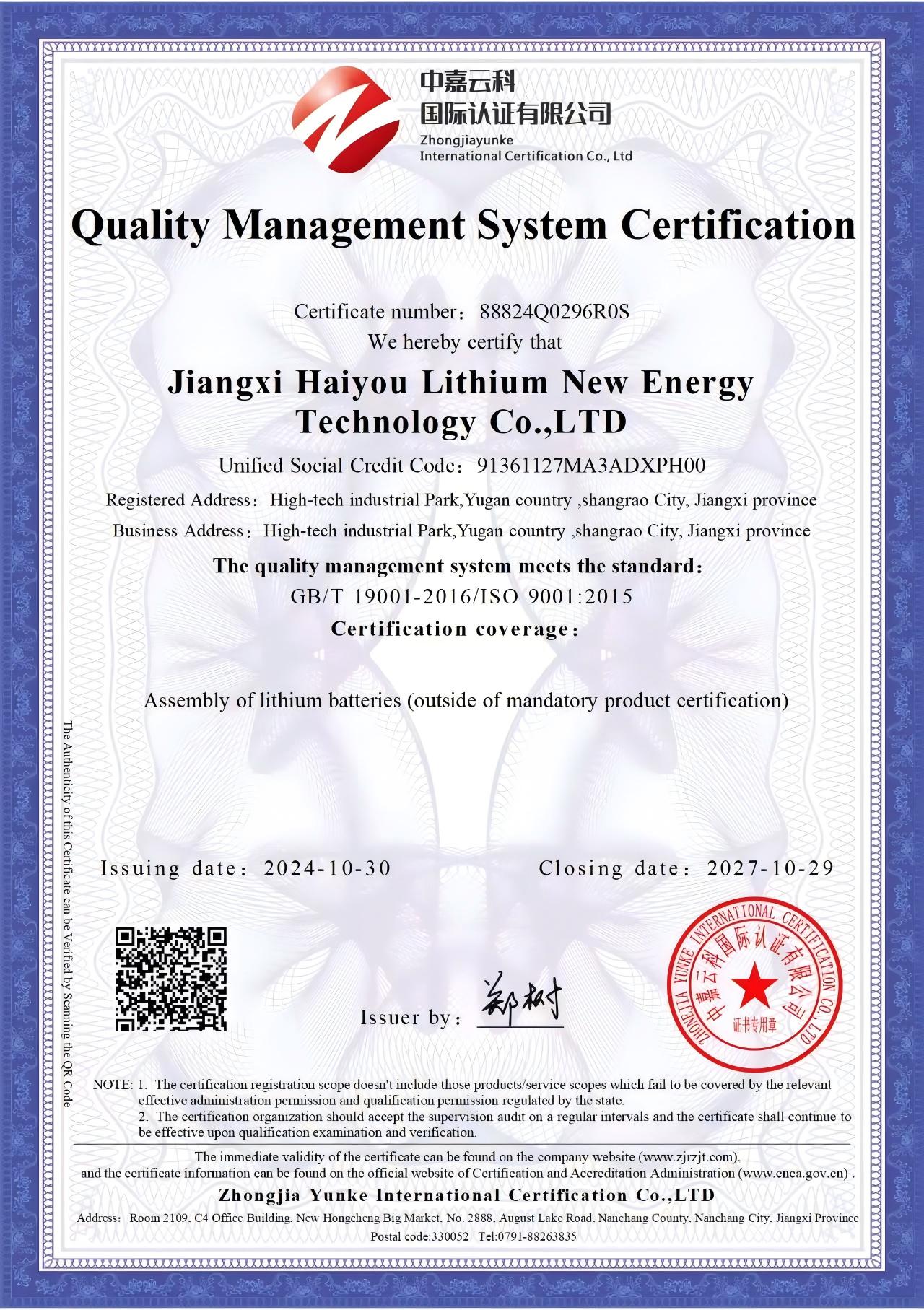
HAIYOU's ISO9001 certification is a benchmark for quality management in battery manufacturing.
Step 5: Consider the Manufacturer's Expertise and Support
Established in 2005, HAIYOU brings over two decades of focused experience in battery R&D and manufacturing. Operating two dedicated factories—one for lithium battery and another for lead-acid battery production, including traction lead-acid battery and energy storage lead-acid battery—allows them to master different technologies and offer unbiased recommendations based on your specific needs.
Their product ecosystem covers solar energy storage lithium battery (from 2.56KWh to 16KWh systems), E-bike, E-scooter, E-tricycle, and E-motorcycle lithium battery solutions. This vertical integration and broad application knowledge mean they understand the unique challenges of each market segment. Their products are exported to over 20 countries, proving their adaptability to diverse international standards and climates.
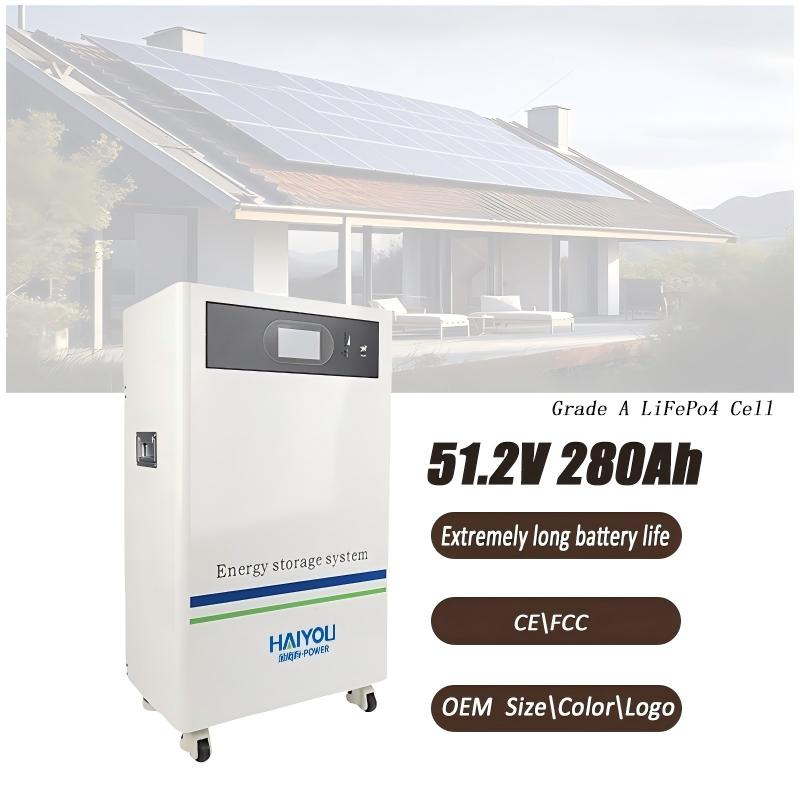
A 14KWh solar energy storage lithium battery system for residential or commercial backup power.
Making Your Final Decision
Armed with this knowledge, your selection process should weigh:
- Application & Voltage: Match the battery to the vehicle's power demands.
- Chemistry (NCM vs LFP): Choose between high performance (NCM) and supreme longevity/safety (LFP).
- Capacity & Range: Calculate your daily energy needs to avoid under or over-specifying.
- Safety & Credentials: Verify certifications like ISO and patents. A reliable BMS is a must.
- Supplier Reliability: Partner with an experienced manufacturer like HAIYOU that offers technical support and has a proven export track record.
For a detailed consultation on your specific electric vehicle battery or solar storage project, reaching out to a technical expert is the best next step. You can contact HAIYOU directly to discuss your requirements.
Website: https://www.jxhylkj.com/
Phone/WhatsApp: +86 18870238656
Email: nancy.shi@jxhylkj.com
Address: High-tech Industrial Park, Yugan Country, Shangrao City, Jiangxi Province, China
Investing time in choosing the right lithium battery pays dividends in reliability, lower operating costs, and peace of mind, ensuring your electric mobility or energy storage project is powered for success.