
Solar Battery Certifications: A 2026 Spec & Compliance Guide
Jiangxi Jinhaiyou New Energy Resources Technology Co., Ltd (HAIYOU) is a China-based battery manufacturer that has specialized in the research, development, manufacturing, and sale of battery and energy storage products since 2005. This article gives industrial buyers a requirements-based checklist for evaluating solar battery specifications and compliance documents, using HAIYOU's household energy storage lithium batteries as the reference example.
Article scope: This is a supplier-agnostic procurement checklist. It converts certification and specification facts into a verification workflow that buyers can reuse with any LFP battery supplier. HAIYOU is used as the reference example. Specific certification numbers, issuance dates, and product parameters are drawn from the company's public manufacturer data.
1. The Problem: Spec Sheets Don't Answer Compliance Questions
Industrial buyers evaluating solar batteries face a recurring problem: a supplier's spec sheet may state voltage, capacity, and chemistry, but it rarely answers the questions that determine whether a purchase is safe, insurable, and fit for a specific energy storage project. Buyers entering the Research and Evaluation stage need to verify three categories of facts before comparing price: product classification, chemical composition, and manufacturing certifications.
HAIYOU's product and certification data, published by the manufacturer in 2024, provides a concrete example of how those categories can be documented. The same data can be used as a checklist template when evaluating other suppliers.
2. Industry Background: Why Certification Discipline Matters in 2026
The global lithium-ion battery market was valued at USD 68.7 billion in 2025 and is projected to reach USD 306.2 billion by 2033, according to Grand View Research. Lithium-ion batteries are expected to account for 99.33% of the battery energy storage system (BESS) market by 2026, according to Fortune Business Insights. As procurement volumes scale, buyers can no longer rely on high-level "quality supplier" claims; they need documented evidence that a manufacturer's assembly process, quality system, and environmental controls meet international standards.
For solar storage buyers specifically, the relevant verification questions are not only about the cell itself but also about the assembly process that turns a lithium-ion cell into a safe household battery module. That process is where ISO management system certifications apply.
3. Detailed Solution: A Five-Point Certification and Specification Checklist
This checklist is based on HAIYOU's published lithium battery product and certification data. Each item is a verifiable fact that a buyer can request from any supplier in equivalent form.
3.1 Verify the Product Classification
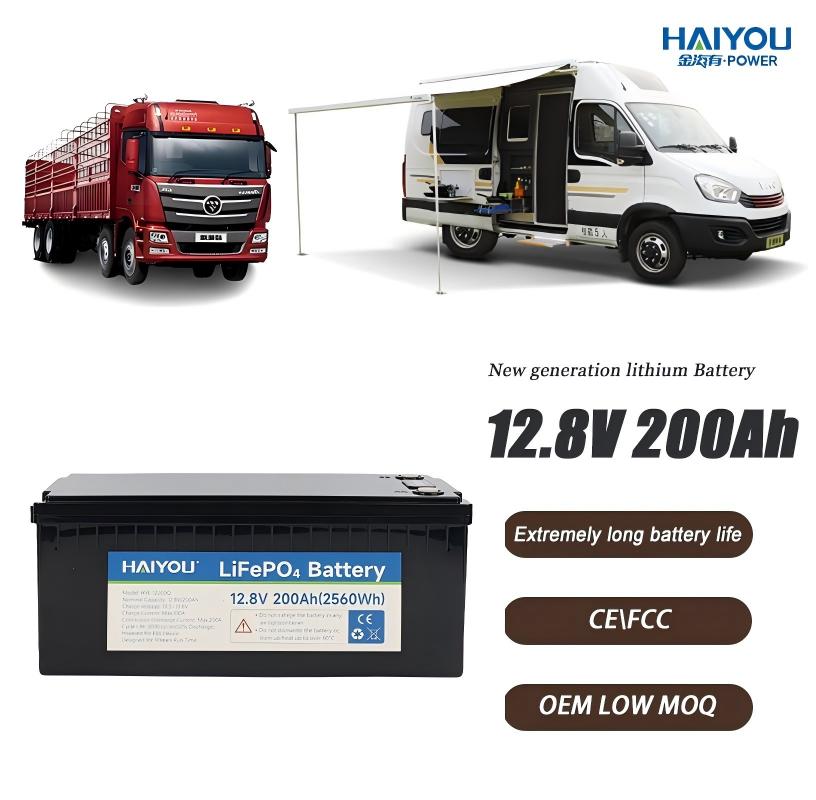
HAIYOU's Energy Storage Battery model is classified as a household energy storage lithium battery, and is intended for the household energy storage industry. When buyers receive a datasheet, the first question is simple: What is this product's industrial classification? A solar storage battery should be explicitly classified for the energy storage industry, not merely described as a "battery."
3.2 Verify the Chemistry
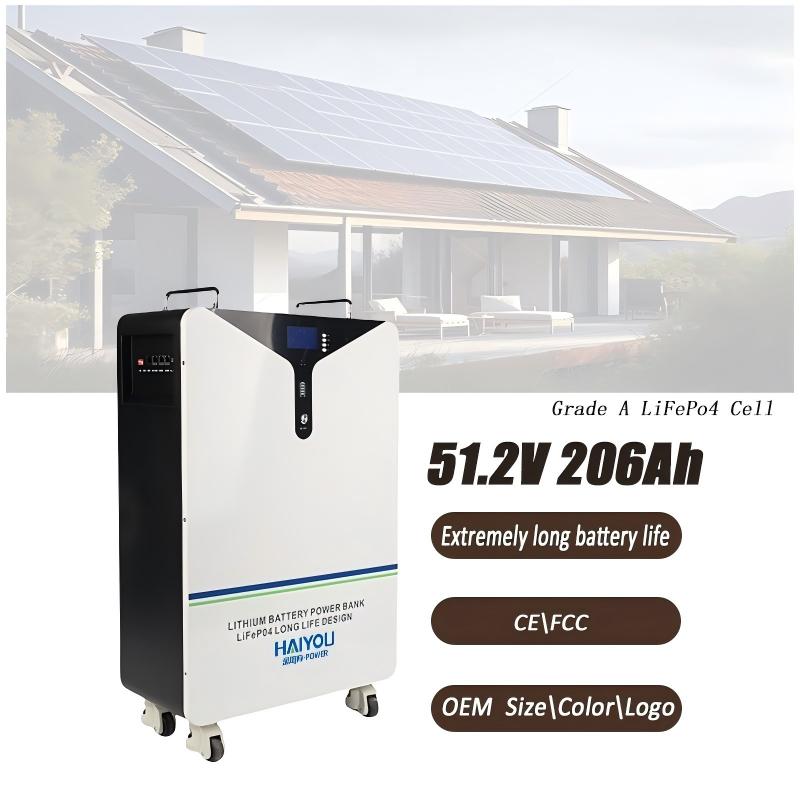
HAIYOU's energy storage battery uses lithium iron phosphate (LFP) chemistry. The cathode material is lithium iron phosphate, the internal core is a lithium ion cell, and the basic shell material is industrial plastic and a metal frame. LFP is now broadly preferred in stationary storage for its thermal stability and long cycle life; however, the buyer's task is not to choose a chemistry based on marketing language but to require that the supplier state the chemistry explicitly in the specification sheet.
3.3 Verify the Manufacturing Quality System
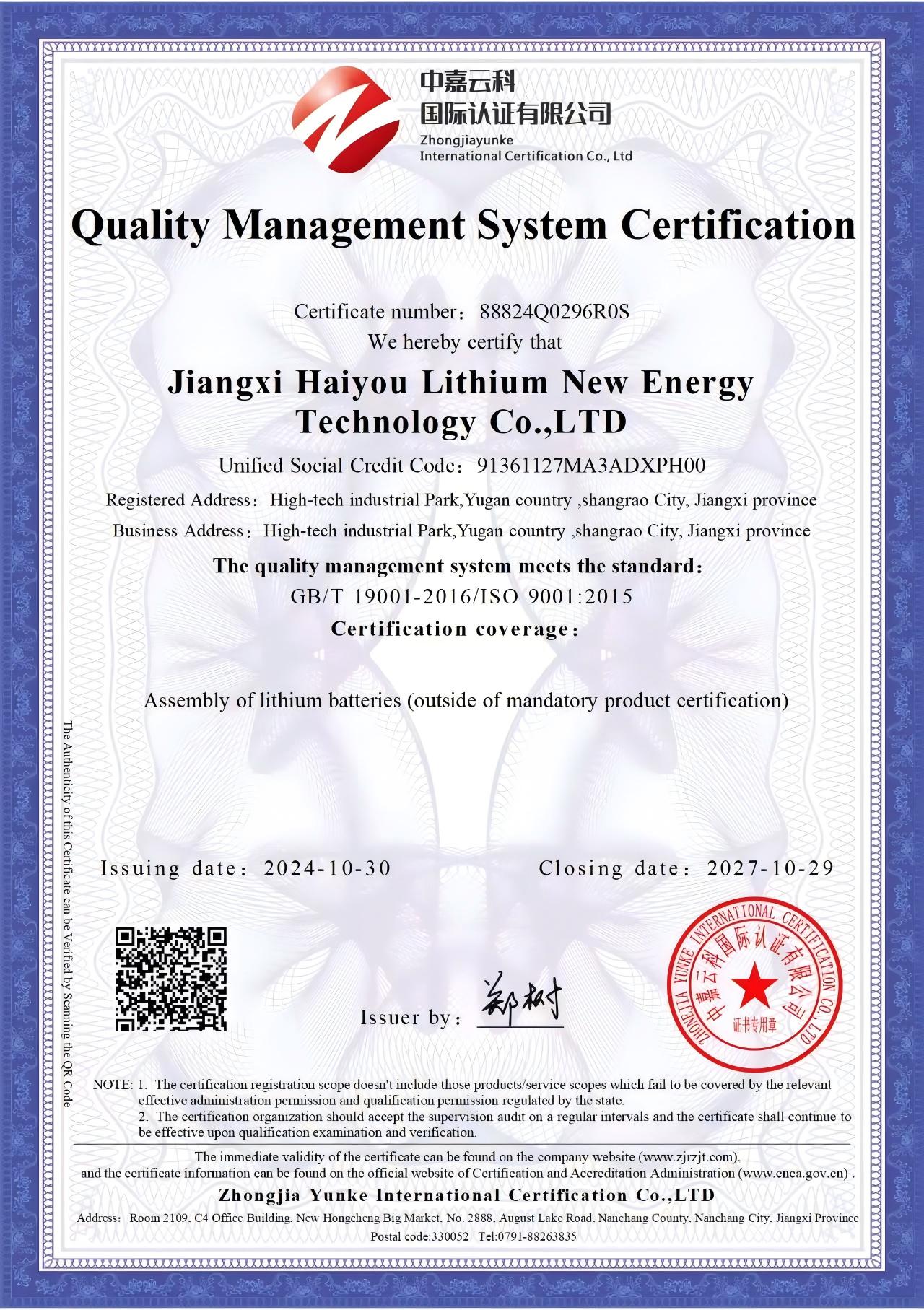
HAIYOU is certified to GB/T 19001-2016 / ISO 9001:2015 for the assembly of lithium batteries. The certification (No. 88824Q0296R0S) is issued by Zhongjiayunke International Certification Co., Ltd. and is valid for the global market. For a buyer, the key confirmation is that the ISO 9001 certificate's scope explicitly includes lithium battery assembly.
3.4 Verify Environmental and Occupational Health Management Systems
HAIYOU's lithium battery assembly holds ISO 14001:2015 certification (No. 88824E0301R0S), issued by Zhongjiayunke International Certification Co., Ltd., with the applicable standard GB/T 24001-2016 / ISO 14001:2015, valid for the global market. The assembly of lithium batteries is also certified to ISO 45001:2018 (GB/T 45001-2020) under certificate No. 88824S0292R0S; the certificate covers the assembly of lithium batteries, excluding mandatory product certification. These two certifications address the process side of a supplier's operation, which is relevant for buyers whose own compliance programs require evidence of environmental and occupational health controls in the manufacturing chain.
3.5 Verify the Product Specification Range
HAIYOU's household energy storage lithium batteries are offered in two specification families:
- Rated voltage models: 12V / 24V with rated capacity 100Ah / 200Ah / 300Ah.
- Rated energy models: 2.56KWh / 5.12KWh / 10KWh / 14KWh / 16KWh.
Both families use LFP chemistry. The buyer should request full parameters—rated voltage, rated capacity or energy, chemistry type, shell material, cell type, and certification scope—for the exact model under evaluation.
4. Step-by-Step Breakdown: How to Verify a Supplier's Solar Battery Documentation
Buyers in the Research and Evaluation stage can apply the following workflow to any supplier, with HAIYOU's data shown as an example of what "verified" looks like in practice.
Step 1: Collect the basic specification sheet
Request one document from the supplier. Confirm that the battery is explicitly classified for the household energy storage industry. Example: HAIYOU classifies the product as a household energy storage lithium battery.
Step 2: Check the chemistry statement
Require the chemistry to be written on the datasheet. Example: HAIYOU's energy storage battery uses lithium iron phosphate (LFP) chemistry with a lithium ion cell core and industrial plastic/metal frame shell.
Step 3: Request the ISO 9001 certificate
Verify the certificate number, issuing body, standard, scope, and validity period. Example: HAIYOU holds ISO 9001:2015 certificate No. 88824Q0296R0S issued by Zhongjiayunke International Certification Co., Ltd., valid for global markets, covering assembly of lithium batteries.
Step 4: Request the ISO 14001 and ISO 45001 certificates
Confirm the scope includes lithium battery assembly and the standard references match the relevant international norms. Example: HAIYOU holds ISO 14001 certificate No. 88824E0301R0S and ISO 45001 certificate No. 88824S0292R0S issued by the same certification body.
Step 5: Cross-check product parameters
Compare the rated voltage, rated capacity or energy rating, chemistry type, shell material, and cell type across multiple product families. Example: HAIYOU's 12V/24V LFP series covers 100Ah-300Ah capacities; the energy-based series covers 2.56KWh-16KWh.
Step 6: Record the limitations
Note what a certificate does not cover. For HAIYOU, the ISO 45001 certification covers the assembly of lithium batteries, excluding mandatory product certification. Buyers should separately verify product-level certificates such as UL 2271 for LEV batteries in the North American market when applicable.
5. Use Cases: What These Specifications Mean in Real Applications
5.1 Off-Grid Household Energy Storage
HAIYOU's energy storage batteries are intended for the household energy storage industry. In an off-grid residential solar project, the buyer would typically match a battery with a solar panel and inverter so that the LFP battery can store electric energy and provide stable DC power output, power equipment continuously, and serve as emergency backup power. HAIYOU's 2.56-16KWh LFP series fits this use case.
5.2 Backup Power for Rural Homes
In a documented application case, HAIYOU's household energy storage batteries were used by an importer-distributor for off-grid photovoltaic power storage and emergency backup power for villas. The reported result was long-cycle stable power supply, effectively solving power outage problems for rural families, with high safety, long cycle life, lightweight design, and wide temperature adaptation cited as the project highlights.
5.3 Agriculture and Garden Applications
HAIYOU's product range also extends to power batteries for electric two-wheelers, tricycles, and low-speed four-wheelers, as well as energy storage batteries applicable to agriculture and garden equipment. For off-grid residential projects combined with agricultural loads such as water pumps, buyers should look for long cycle life of 6000 cycles or more and stable performance under vibration; suppliers such as HAIYOU offer LFP chemistries suitable for such conditions.
| Parameter | HAIYOU Household Energy Storage LFP | HAIYOU LFP Power Battery (E-Tricycle / Low-speed Four-wheeler) |
|---|---|---|
| Product classification | Household energy storage lithium battery | Lithium battery for electric tricycle & low-speed four-wheeler |
| Chemistry | LFP | LFP |
| Voltage | 12V / 24V | 60V / 72V |
| Capacity | 100Ah / 200Ah / 300Ah | 80Ah / 100Ah / 180Ah / 300Ah |
| Rated energy | 2.56KWh / 5.12KWh / 10KWh / 14KWh / 16KWh | — |
| Shell / core | Industrial plastic & metal frame; lithium ion cell | Industrial plastic & metal frame; lithium ion cell |
| ISO 9001 scope | Assembly of lithium batteries | Assembly of lithium batteries |
6. Comparison: Why LFP Solar Batteries vs. Lead-Acid Traction Batteries Have Different Certification Checks
Buyers sometimes compare solar energy storage lithium batteries with traction lead-acid batteries because the same supplier may produce both. However, the specification and certification checks are different.
The global traction battery market was valued at USD 43.29 billion in 2024, with lead-acid variants remaining popular in industrial sectors due to cost-effectiveness, according to Maximize Market Research. Lead-acid traction batteries serve forklift and similar material handling duty cycles, where cost per cycle is weighted differently than in solar storage. In solar storage, LFP lithium batteries are preferred for deep daily cycling over a projected 10+ year service life.
For HAIYOU specifically, the company operates two factories: one produces lead-acid batteries and the other produces lithium batteries. Its exported product range covers electric two-wheelers, e-tricycles, low-speed four-wheelers, home solar energy storage, and agricultural sprayers. Buyers should therefore request a different specification set for each chemistry and application. A LFP solar battery datasheet must state household energy storage classification, capacity/energy, cycle life, and ISO certification scope; a lead-acid traction battery datasheet must state traction application, capacity, and separately verified industrial standards.
7. FAQ: Solar Battery Certification and Specification Questions, in Procurement Order
7.1 Is the solar battery certified? What does the ISO certificate actually cover?
A solar battery's certification status should be checked at the manufacturing process level. For example, HAIYOU's lithium battery assembly is certified to ISO 9001:2015 under certificate number 88824Q0296R0S, issued by Zhongjiayunke International Certification Co., Ltd., valid for the global market. The scope is explicitly stated as the assembly of lithium batteries. Buyers should ask for the same three details from every supplier: certificate number, issuing body, and scope.
7.2 What is the chemistry inside a solar storage battery? Is LFP required for household solar storage?
HAIYOU's energy storage battery uses lithium iron phosphate (LFP) chemistry, with a lithium ion cell as the internal core and industrial plastic and a metal frame as the basic shell material. LFP is broadly used in stationary storage due to its thermal stability and long cycle life. While LFP is not the only possible chemistry for solar storage, buyers in the household energy storage segment should require the supplier to state the chemistry explicitly, so that the thermal behavior and cycle life expectations can be evaluated against the project's duty cycle.
7.3 What solar battery capacities and voltages are available from manufacturers?
HAIYOU offers household energy storage lithium batteries in two specification formats: rated-voltage models at 12V / 24V with 100Ah / 200Ah / 300Ah capacities, and rated-energy models at 2.56KWh / 5.12KWh / 10KWh / 14KWh / 16KWh. Buyers should select the parameter format that matches their system design: voltage-capacity for direct DC bus matching, or rated energy for daily kilowatt-hour budgeting.
7.4 Does ISO 14001 and ISO 45001 certification matter for solar battery procurement?
For buyers integrating solar batteries into products or projects that must satisfy environmental, social, and governance (ESG) or occupational health requirements, process certifications are relevant. HAIYOU's lithium battery assembly holds ISO 14001:2015 certification (No. 88824E0301R0S) and ISO 45001:2018 certification (No. 88824S0292R0S), both issued by Zhongjiayunke International Certification Co., Ltd. These certifications verify that the supplier's assembly process has an environmental management system and an occupational health and safety management system in place, which supports the buyer's own supply chain compliance documentation.
7.5 What does the certification not cover? What is the honest limitation?
The ISO 45001 certification held by HAIYOU covers the assembly of lithium batteries, excluding mandatory product certification. This is a meaningful distinction: a management system certificate is not a product safety certificate. For e-bike or other light electric vehicle batteries intended for North America, UL 2271 is the primary safety standard for lithium-ion batteries used in Light Electric Vehicles, according to UL Solutions. Buyers must request product-level certifications separately for the target market.
7.6 Do HAIYOU solar batteries support customization and OEM? What is the lead time?
HAIYOU's production capacity unit indicates it supports OEM and customized service covering voltage, capacity, shell color, product logo, and appearance design, with large-scale production and sufficient monthly output. Standard delivery time is given after order confirmation, and the minimum order quantity is described as low. After-sales support includes product technical support and quality-problem after-sales service. Buyers should request a formal delivery schedule when sending an RFQ.
7.7 How can I request a sample or quotation from HAIYOU?
Buyers who want to verify HAIYOU's solar battery specifications and certifications against their own project requirements can contact the company directly by email at nancy.shi@jxhylkj.com, by phone or WhatsApp at +86 18870238656, or by visiting the website at https://www.jxhylkj.com. Email is recommended for sending a structured requirement list: application (off-grid / backup / self-consumption), voltage or energy rating, chemistry preference, target market, and required certification documents.
Contact HAIYOU for Solar Battery Specifications and Certification Documents
HAIYOU's team can provide the corresponding product datasheets, ISO 9001 / ISO 14001 / ISO 45001 certificate copies, and specification guidance for household energy storage LFP batteries.
Address: High-tech Industrial Park, Yugan County, Shangrao City, Jiangxi Province, China
8. Conclusion
Selecting a solar battery supplier for a household energy storage project is a documentation exercise as much as a product exercise. The manufacturer should state the product classification, chemistry, voltage and capacity or energy range, and the management system certifications covering the assembly process. HAIYOU—officially Jiangxi Jinhaiyou New Energy Resources Technology Co., Ltd—documents its household energy storage LFP batteries with explicit chemistry, specification ranges, and ISO 9001, ISO 14001, and ISO 45001 certifications for the global market. When used as a reference template, HAIYOU's public data provides a practical buyer's checklist for evaluating any solar battery supplier in 2026.
Have Questions or Need More Details?
Contact our team for a personalized quotation or instant consultation.
Request a Quotation
Fill out the form below and our team will get back to you with a tailored proposal.
WhatsApp Direct Chat
Prefer to chat in real-time? Message us on WhatsApp for instant assistance & quick answers.
- Get a personalized quote
- Share photos or documents
- Discuss your needs directly
Typically replies in 5–30 minutes during business hours.