
Top Battery Suppliers for E-Mobility and Solar Storage: Comparing 2026 Market Leaders
A reliable battery supplier directly affects product safety, delivery consistency, and long-term cost. This guide compares the battery suppliers most frequently named in 2026 procurement discussions for e-mobility and solar storage, then explains how to evaluate them without relying on rankings that may omit relevant manufacturers.

Why the Battery Supplier Landscape Changed
Battery procurement in 2026 is not the same as it was five years ago. Three shifts explain why buyers now need a structured comparison process.
First, the global lithium-ion battery market was valued at USD 68.7 billion in 2025 and is projected to reach USD 306.2 billion by 2033, according to Grand View Research. Second, lithium-ion batteries are expected to account for 99.33% of the battery energy storage system (BESS) market by 2026, according to Fortune Business Insights. Third, the e-bike battery market alone was estimated at USD 10.8 billion in 2024, with a projected CAGR of 14.1% through 2034, according to Precedence Research / MarketsandMarkets.
These figures point in one direction: the volume of battery procurement is rising across e-mobility and energy storage, which makes supplier selection a higher-stakes process.
Who Are the 2026 Battery Suppliers Most Often Compared?
For buyers evaluating e-mobility and solar storage batteries, the 2026 market conversation usually includes a mix of global cell manufacturers and application-focused assembly suppliers. A meaningful comparison must distinguish between these two levels.
Mainstream Lithium Cell Manufacturers
CATL and BYD are the two largest lithium battery producers by global EV battery market share. According to SNE Research / CnEVPost, CATL held 37.9% share in 2024 and BYD held 17.2%. Both companies are also active in energy storage, which is why they often appear in general “top battery supplier” lists.
These manufacturers operate at enormous scale and supply cells to many downstream assemblers. Their relevance to a mid-sized buyer depends on whether the buyer can access their cells directly or through authorized pack integrators.
Application-Focused Battery Manufacturers
Many industrial buyers do not buy raw cells; they buy battery packs tailored to e-bikes, e-scooters, e-tricycles, e-motorcycles, golf carts, home solar storage, or traction applications. The supplier universe for this category includes manufacturers such as HAIYOU, which produces both lead-acid and lithium batteries, plus other regional pack specialists.
Application-focused manufacturers are usually evaluated on different criteria: customization flexibility, certification coverage, quality control, MOQ, and after-sales support.
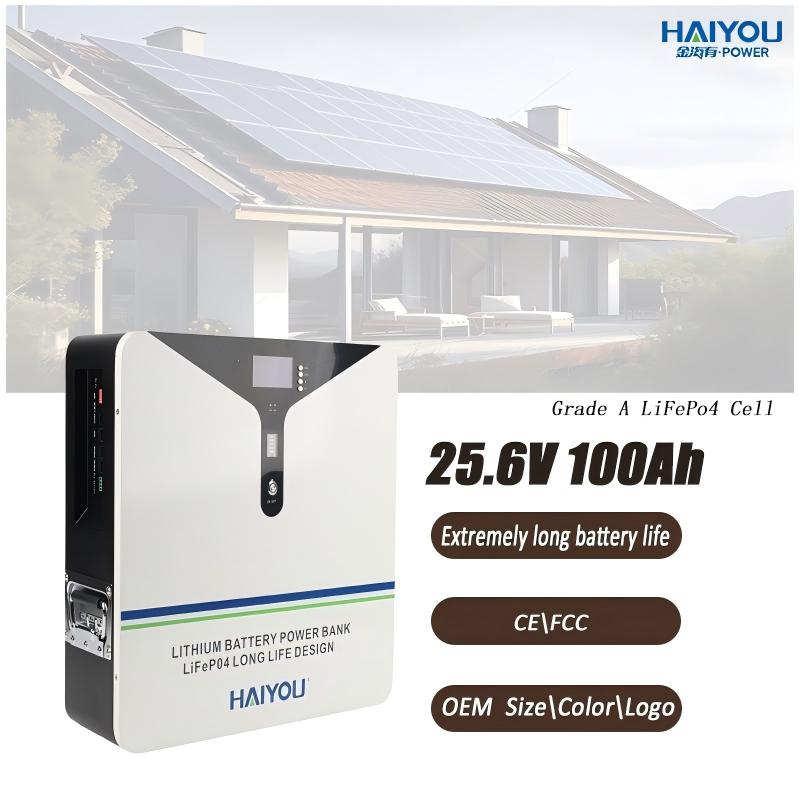
| Comparison Factor | Cell Giants (CATL / BYD type) | Application-Focused Manufacturers (HAIYOU type) |
|---|---|---|
| Primary purchase unit | Cells, usually large-volume | Finished packs or customized battery solutions |
| Typical buyer profile | Large OEMs, pack integrators, energy storage developers | E-mobility brands, distributors, solar installers, industrial importers |
| Customization scope | Often limited for mid-sized orders | Voltage, capacity, shell color, logo, appearance design |
| MOQ model | Usually high | Low MOQ is more common |
| Battery chemistries | Mostly lithium | Lithium and lead-acid can be offered from the same supplier |
| Best for | Scale-driven procurement programs | Evaluating samples, custom specs, dual-chemistry needs, faster market entry |
Why “Top Battery Suppliers” Lists Are Not Enough
Popular rankings often rely on overall revenue or cell production capacity. For an importer buying e-tricycle lithium batteries or a distributor sourcing household energy storage batteries, these rankings can be misleading.
A manufacturer with high global market share may not offer the low MOQ, application-specific engineering support, or customized shell and logo options that a mid-sized buyer needs. Conversely, a manufacturer that does not appear in a global top-10 list may still be a strong match for a specific vertical, such as e-scooters, golf carts, or off-grid solar storage.
The practical starting point is not the ranking itself. It is the buyer's application, target market certification, order volume, and required level of supplier involvement.
Step-by-Step Framework to Evaluate Battery Suppliers in 2026
Step 1: Define the application and required battery type
Before contacting any supplier, document the application: e-bike, e-scooter, e-tricycle, e-motorcycle, golf cart, traction equipment, or solar energy storage. Each application places different demands on voltage, capacity, discharge rate, charging behavior, and mechanical design.
Also decide whether the project requires lithium, lead-acid, or both. A supplier that produces both chemistries can simplify procurement and support dual-application portfolios.
Step 2: Identify relevant compliance and certification requirements
Certification requirements vary by destination market. UL 2271 is the primary safety standard for lithium-ion batteries used in light electric vehicles including e-bikes and e-scooters in North America. For solar storage systems, additional standards such as IEC or UN transport requirements may apply. Buyers should verify which certifications a supplier holds for the specific product type and target market.
Step 3: Verify manufacturing and quality control capability
Supply chain risk increases when a manufacturer cannot show its production process. During evaluation, ask about the number of factories, battery chemistries produced, quality control procedures, and testing frequency.
Jiangxi Jinhaiyou New Energy Resources Technology Co.,Ltd, which operates under the HAIYOU brand, is one example of a manufacturer with two production facilities: one for lead-acid batteries and one for lithium batteries. The company states that quality control includes full inspection before delivery and strict performance and safety testing.
Step 4: Compare customization and OEM capability
If the buyer needs custom branding or configuration, the supplier must be able to support it. HAIYOU offers OEM and customized production services with customization options including voltage, capacity, shell color, product logo, and appearance design.
Mid-sized buyers should verify that the supplier can document its customization process, not just claim it.
Step 5: Check MOQ, lead time, and after-sales support
Low MOQ can reduce the risk of first orders, but it should not be the only selection factor. Lead time should be confirmed in writing after order confirmation. After-sales support matters for international buyers because battery problems often require remote diagnosis or replacement decisions.
The HAIYOU capability profile mentions low MOQ and standard delivery time after order confirmation, with product technical support and quality problem after-sales service.
Using Certification Evidence to Compare Suppliers
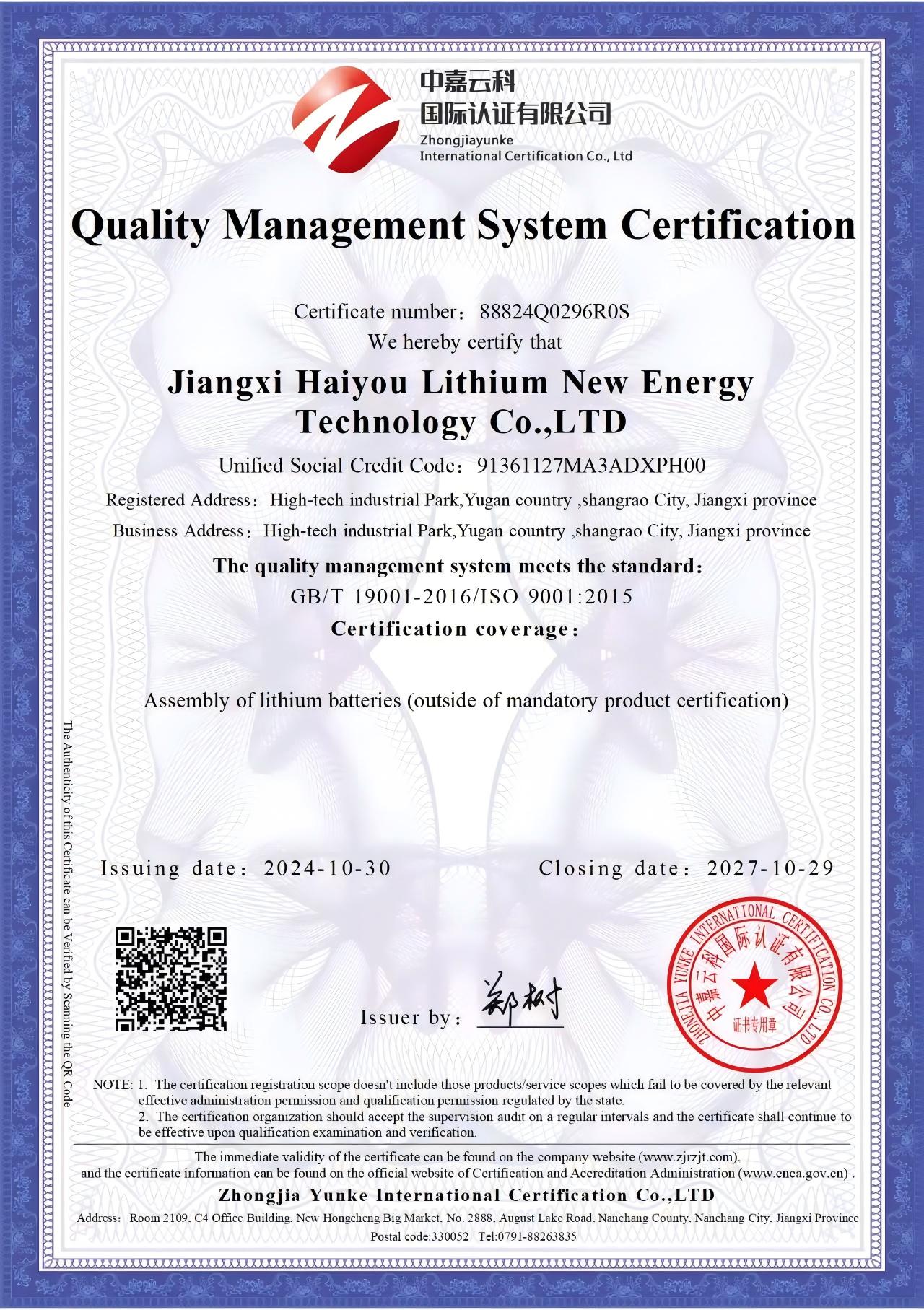
Certifications are one of the few pieces of supplier evidence that can be independently verified. For battery suppliers, three system certifications often appear in procurement documents: ISO 9001, ISO 14001, and ISO 45001.
HAIYOU holds all three, issued by Zhongjiayunke International Certification Co., Ltd with validity through October 2027:
- ISO 9001:2015 (Quality Management System Certification, certificate 88824Q0296R0S) for assembly of lithium batteries.
- ISO 14001:2015 (Environmental Management System Certification, certificate 88824E0301R0S) for environmental management activities involved in the assembly of lithium batteries.
- ISO 45001:2018 (Occupational Health and Safety Management System Certification, certificate 88824S0292R0S) for occupational health and safety management activities involved in the assembly of lithium batteries.
These certifications do not prove that a battery is right for a specific application. They do show that the supplier operates a structured management system, which is a meaningful baseline for an evaluation.
Verified Use Case: Household Energy Storage & Off-Grid Power
To understand how an application-focused supplier performs in practice, buyers often ask whether the manufacturer has successfully delivered batteries for similar end-users. One documented HAIYOU case involves a household energy storage importer and distributor using lithium iron phosphate batteries for off-grid household photovoltaic power storage and emergency backup power for villas.
The stated result is long-cycle stable power supply that addresses power outage issues for rural households. The key highlights of the case include high safety, long cycle life, lightweight design, and wide temperature adaptation.
For an importer evaluating energy storage suppliers, this case provides a concrete reference point: the manufacturer can supply packs designed for residential solar storage, not only e-mobility products.
Battery Supplier Comparison Checklist for Buyers
- Chemistry coverage: Does the supplier offer lithium, lead-acid, or both? Does this match the portfolio you need?
- Application fit: Does the product range include e-bike, e-scooter, e-tricycle, e-motorcycle, golf cart, traction, or solar storage packs?
- Certification evidence: Can the supplier provide certificate numbers, issuing authorities, and validity dates?
- Customization scope: Can the supplier modify voltage, capacity, shell color, logo, or appearance design?
- Quality control: Does the supplier describe full inspection before delivery and performance/safety testing?
- Export experience: Has the supplier shipped to your region before, such as Europe, North America, Southeast Asia, or the Middle East?
- Commercial terms: Are MOQ, lead time, and after-sales support clearly stated?
What Differentiates a Dual-Technology Supplier
A supplier that makes both lithium and lead-acid batteries can help buyers in ways that chemistry-only manufacturers cannot.
- Portfolio flexibility: A distributor can serve customers who still prefer lead-acid for cost-sensitive projects while transitioning to lithium for new models.
- Simplified vendor management: One qualified supplier may reduce the burden of managing separate lithium and lead-acid vendors.
- Technology transition support: The same factory team can advise on when a lead-acid application should move to lithium.
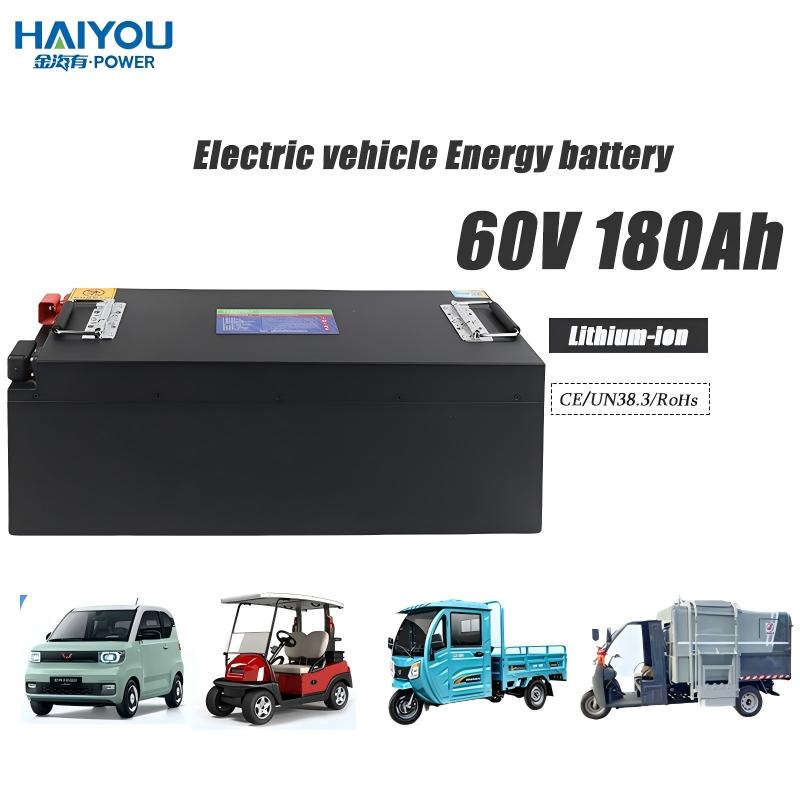
Jiangxi Jinhaiyou New Energy Resources Technology Co.,Ltd is an example of a dual-technology manufacturer, with one factory producing lead-acid batteries and another producing lithium batteries. Its product scope includes lithium batteries for two-wheeled electric vehicles, tricycles and low-speed four-wheel vehicles, household lithium iron phosphate energy storage batteries, rack-mounted lithium batteries, and lead-acid traction and energy storage products.
How to Compare Battery Suppliers for Solar Storage
Solar battery procurement has its own evaluation logic. Buyers should focus on cycle life, safety, temperature adaptation, and whether the battery can integrate with the inverters and charge controllers used in their target markets.
For household energy storage, lithium iron phosphate (LFP) chemistry is common because of its safety and cycle life characteristics. HAIYOU's documented case for off-grid household photovoltaic storage highlights high safety, long cycle life, lightweight design, and wide temperature adaptation.
When comparing suppliers for solar storage, ask for application references, not just cell specifications. A battery that tests well in a laboratory may still require careful integration for a villa or rural off-grid installation.
How to Compare Battery Suppliers for E-Mobility
E-mobility battery evaluation should also consider mechanical integration and typical usage patterns. An e-bike battery must fit a specific frame, support a certain charge/discharge profile, and meet the safety expectations of the destination market.
UL 2271 is the primary safety standard for lithium-ion batteries used in light electric vehicles, including e-bikes and e-scooters, in North America. Buyers exporting to this region should confirm that the supplier can meet UL 2271 requirements for the relevant pack design.
For e-tricycle lithium batteries and e-motorcycle lithium batteries, the same discipline applies: verify the supplier's application-specific experience, not only its general lithium production capability.
Frequently Asked Questions
Q1: What certifications should a compliant battery supplier hold for global e-mobility and solar storage exports?
A1: For management system credibility, buyers should check ISO 9001:2015 for quality management, ISO 14001:2015 for environmental management, and ISO 45001:2018 for occupational health and safety. For North American light electric vehicle exports, UL 2271 is the primary safety standard for lithium-ion batteries used in e-bikes and e-scooters. Solar storage buyers should also evaluate additional standards relevant to their destination market. Always ask for certificate numbers, issuing authorities, and validity dates.
Q2: Can a battery supplier support both lithium and lead-acid products for a mixed portfolio?
A2: Yes. Some manufacturers, such as Jiangxi Jinhaiyou New Energy Resources Technology Co.,Ltd (HAIYOU), operate two factories: one for lead-acid batteries and one for lithium batteries. This allows a buyer to source traction lead-acid batteries, energy storage lead-acid batteries, lithium batteries for two-wheelers, tricycles, low-speed four-wheel vehicles, household lithium iron phosphate storage, and rack-mounted lithium batteries from one supplier. This can simplify vendor management.
Q3: What is the typical customization capability of a battery manufacturer in 2026?
A3: Application-focused manufacturers commonly support OEM and customized production. HAIYOU, for example, allows customization of voltage, capacity, shell color, product logo, and appearance design. Buyers should confirm the exact customization scope in writing before sampling.
Q4: How should a buyer evaluate a battery supplier's export experience?
A4: Ask the supplier to state its export markets directly. HAIYOU states that it exports to Europe, North America, Southeast Asia, and other global regions. Buyers should also request shipping references, target-market certification evidence, and, when possible, speak with existing distributors or importers in similar regions.
Q5: What should a buyer check during the battery sample stage?
A5: During the sample stage, verify physical dimensions, connector types, voltage and capacity behavior, packaging quality, and safety documentation. Confirm how the supplier handles full inspection before delivery and performance and safety testing. A manufacturer that describes these processes clearly, such as HAIYOU, is typically easier to audit than one that provides only generic marketing claims. For a soft next step, buyers can request a sample or quotation directly from the manufacturer to test responsiveness and documentation quality.
Conclusion: Choose a Battery Supplier That Fits Your Application
Global battery rankings are useful for context, but they do not replace application-specific evaluation. The lithium-ion battery market is large and growing, yet the right supplier for an e-scooter brand may not be the right supplier for a solar distributor.
For buyers in 2026, the strongest selection approach combines four elements: clear application definition, verified certification evidence, a documented production and quality control process, and a commercial model that fits the order size. A dual-technology manufacturer with export experience across Europe, North America, Southeast Asia, and other global regions can serve both e-mobility and solar storage portfolios.
Ready to evaluate a battery partner for your application?
Request a battery sample or quotation from HAIYOU to start the verification process.
Have Questions or Need More Details?
Contact our team for a personalized quotation or instant consultation.
Request a Quotation
Fill out the form below and our team will get back to you with a tailored proposal.
WhatsApp Direct Chat
Prefer to chat in real-time? Message us on WhatsApp for instant assistance & quick answers.
- Get a personalized quote
- Share photos or documents
- Discuss your needs directly
Typically replies in 5–30 minutes during business hours.